Throughout your journey to becoming a lawyer, you will study textbooks and listen to lectures. However, the real learning and transformation begin once theory meets practice – and that’s where moot court comes in.
For any future legal professional, moot court is more than an academic exercise – it is essentially a simulation of real-life courtroom proceedings to improve legal knowledge and advocacy skills and courtroom conduct.
Whether you’re at the start of your law degree or preparing for your first competition, an understanding of the significance of moot court for law students can be a large advantage.
Let’s look at what moot court is, why it is important, and how educational institutions such as K.R. Mangalam University are developing future legal minds through valuable mooting processes (simulated court proceedings).
What is Moot Court?
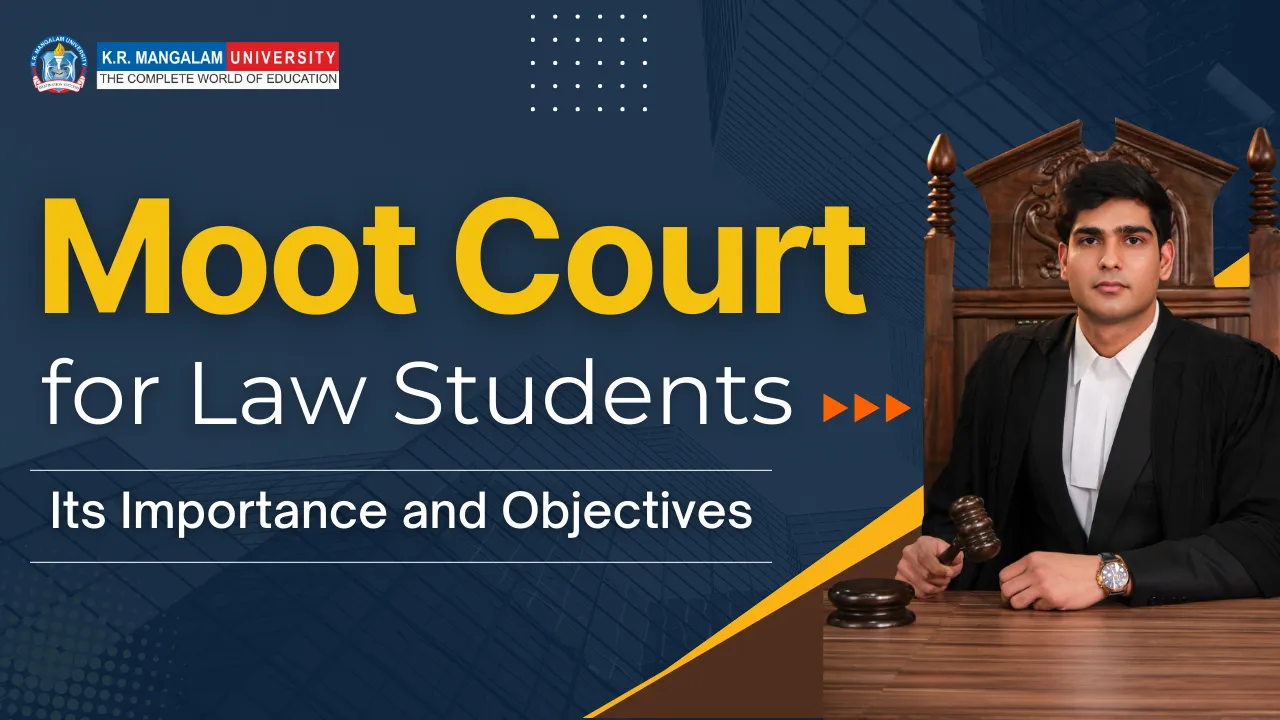
A moot court is an artificial court proceeding where law students argue imaginary cases as practice. Generally, a moot court mimics appellate or Supreme Court-type proceedings where students must argue using legal arguments from fictional problems, rather than questioning witnesses or presenting factual evidence.
At the moot court, participants can be advocates, researchers, and drafters who prepare written memorials (arguments) and then present them orally to a panel of judges. Judges can be professors, practising lawyers, or real judges who provide real and valuable feedback.
Moot courts provide law students with a unique opportunity to engage complex legal issues and apply relevant statutes and precedents. Students develop legal arguments just as they would in a real-life court.
Moot Court for Law Students
So, why is moot court an essential component of legal education?
For law students, moot court means more than just getting involved in a co-curricular activity. It contributes to the important incubation of legal talent, facilitating the transition of law students from the role of passive academic learners to a more active and confident, passionate advocate. Here is how it does this:
- Experiential Learning: The vocational nature of mooting teaches students to apply theoretical and practical concepts to hypothetical situations, thereby enhancing their understanding of the law.
- Confidence Building: There is a definite connection between training to present arguments to an audience and increasing students’ self-awareness and confidence to speak in public.
- Critical Thinking Skills: Mooting demands analysis, logical reasoning, rebuttal, and so forth, and encourages students to think on their feet, logically and strategically, about problems.
- Research Skills: Legal research is a large, difficult part of the moot court experience; however, mooting trains students to contextualise, find, and assimilate appropriate case laws and statutes.
Also Read: Explore the Top Law Courses at K.R. Mangalam University
Importance of Moot Court for Law Students
Many law graduate students report that their first experience of participating in a moot court was a real transformative process, where the theory of law emerged as a practical and intellectual reality beyond an academic textbook.
Participation in a moot court cultivates a number of other anticipated legal skills and life skills, including:
Legal Research and Drafting Skills
Preparing for a moot court competition necessitates legal research, along with the detailed and careful writing or drafting of legal memorials. Thus, moots develop writing precision and analytical skills.
In the words of Justice Indu Malhotra, former Judge, Supreme Court of India, “Mooting is the best way to learn how to understand and what the law is argued, interpreted, and evolved.”
Oral Advocacy
Mooting will train the student to present and defend their position in a clear argument and also respond to curious and demanding questions from the bench, i.e., judges, making it consistent with the external environment of a courtroom.
Teamwork
Most moot courts operate as teams or groups, which engages the virtues of teamwork, coordination, mentoring/peer learning – life skills equally to our legal skill set.
Networking and Exposure
Moot court competitions almost always gain exposure to high-level and eminent judges and legal practitioners or peers from other colleges or universities and establish their early professional networks.
Career Potential
Moot court participation adds substantial value to CVs because places like law firms and chambers see it not only as an indicator of initiative and intellect, but also as a significant undertaking of commitment. Given the quality of many firms’ practices, it is becoming more common to seek the transformative potential that is mooted.
What is the Main Objective of a Moot Court?
The primary goal of a moot court is to narrow the divide between academic law school instruction and real-life courtroom practice. Consequently, it aims to:
- Develop skills in reasoning and legal interpretation
- Develop skills in public speaking and effective communication
- Develop skills in advocacy and rebuttal
- Teach students the dos and don’ts of courtroom protocol and court conduct
- Encourage students to develop legal arguments based on research
Above all else, moot court aims to equip students to think like lawyers well before they access actual courtrooms.
Engaging Quotes and Data
We can back this up by looking at the data and the reactions of actual lawyers:
- A survey by Bar & Bench in 2022 indicated that 72% of law students felt that mooting had a significant positive impact on their research and oral advocacy skills.
- A report by Live Law stated that graduates who had mooted are 35% more likely to make it to an internship in a top-tier law firm.
- “A good mooter is usually a good lawyer. The skills you learn in mooting stay with you throughout your career.” Says Gopal Subramanium, Senior Advocate and former Solicitor-General of India.
These experiences reinforce the idea that mooting is much more than an academic exercise; it is a career-forming experience!
Law Programmes at K.R. Mangalam University
At K.R. Mangalam University (KRMU), students receive more than just book knowledge in their legal education. Rather, KRMU’s School of Legal Studies combines knowledge from a textbook and hands-on experience, ensuring the students are ready for a day in the courtroom, a position in corporate firms, or a role in public policy making.
Law Programme Structure & Fees at KRMU
| Programme |
Duration |
Semester I Fee |
Semester II Fee |
Annual Fee |
Key Highlights |
| BBA LL.B. (Hons.) |
5 years |
₹95,000 |
₹90,000 |
₹1,85,000 |
Combines law with business & management studies |
| B.A. LL.B. (Hons.) |
5 years |
₹95,000 |
₹90,000 |
₹1,85,000 |
Integrates law with social sciences & humanities |
| LL.B. (Hons.) |
3 years |
₹80,000 |
₹80,000 |
₹1,60,000 |
Focused legal education for graduates from any field |
What Makes KRMU’s Law Programmes Stand Out?
- An industry-aligned curriculum is created to include important industry insights as the curriculum development process is conducted collaboratively with legal practitioners and advocates.
- A modern Moot Court Hall is provided to replicate trial court processes as closely as possible.
- Mandatory internship in law firms, courts, NGOs and corporate counsel divisions.
- A multidisciplinary approach providing context to law, such as incorporating management, political science, technology, et al.
- Offering scholarships, up to 100%, for deserving and meritorious students.
- International experience through student exchanges and fully funded foreign study tours.
Moot Court at K.R. Mangalam University
At K.R. Mangalam University, we appreciate the importance of experiential learning to legal education. We understand that our students will be lawyers, and we have provided our School of Legal Studies with a lively and state-of-the-art moot court hall that mimics real-life courtrooms while also aiding presentation and confidence.
Some of the key features of the moot court at K.R. Mangalam University are as follows:
- Modern moot court facilities
- Structured sessions by veterans of the law, backed by mentors from academia
- Fully fledged national moot court competitions hosted annually
- Workshops on legal research, drafting, and advocacy
- Experienced attorneys and judges from the First Appellate Centre facilitate these workshops.
Conclusion
To every future lawyer reading this—moot court is your portal to becoming a confident, competent legal professional. It transcends the confines of the lecture theatre and immerses you in the practicalities of legal practice at the level that counts.
Whether you do your first mooting experience or tenth, the experiences you have about the law, arguing a legal position, and self-belief will endure for the rest of your life.
At K.R. Mangalam University, we don’t just deliver the content of Law—we prepare the next generation of leaders of the legal profession through practical experiences like mooting.
So, make sure you leap up, raise your voice, and make your argument! You are in a courtroom.
Also Read: A Guide on PhD in Law: Admission Eligibility & Career Scope
FAQs
Frequently Asked Questions (FAQs)
What is moot court in law school?
A moot court is a simulated court proceeding conducted in law schools and includes students arguing hypothetical legal cases. A moot court is generally conducted in the form of appellate court or Supreme Court hearings, as opposed to trial courts, which would introduce witnesses and factual testimony. Within this context of a moot court, students present and develop legal arguments in advance of judges (an operational panel).
Why is moot court important for law students?
Moot court gives law students practical experience and develops practical skills, including research, reading, drafting, oral and written advocacy, producing legal advice, teamwork, and courtroom manners. It is the bridge between law theory and legal practice and gives it another level of experience and enables a realistic preview of what a lawyer's work will consist of.
Does moot court experience help with law careers?
Absolutely. Moot court experience adds the following values to a law student’s CV:
• Develop skills in reasoning and legal interpretation
• Develop skills in public speaking and effective communication
• Develop skills in advocacy and rebuttal
• Teach students the dos and don'ts of courtroom protocol and court conduct
• Encourage students to develop legal arguments based on research
How does K.R. Mangalam University support moot court activities?
K.R. Mangalam University has a dedicated moot court hall with regular national-level competitions, expert-led workshops, and mentorship from experienced legal professionals. Moot court training is integrated into the legal curriculum from the early semesters, ensuring students receive comprehensive and continual exposure to practical legal education.


























 13+Years of Educational Experience