The concept of experiential learning was proposed by Carl Ransom Rogers. An American psychologist believed that humans are capable of becoming whole people through self-discovery. He stressed the interdependence of our thoughts, feelings, and deeds. We are not separate entities; rather, we’re connected parts of a greater whole. This theory was primarily employed to explain adult learners’ learning mechanisms and then applied to adolescent and school-going learners. In exploring the essence of learning, Rogers identified two types: cognitive and experiential. He described cognitive learning as inherently meaningless unless applied practically, encompassing knowledge such as vocabulary, multiplication tables, mathematical formulas, historical events, and geographical facts. In contrast, experiential learning is crucial for personal development and well-being, involving the practical application of knowledge, such as learning about engines to repair a car or applying psychological principles to help children overcome bad habits.
Experiential learning is learner-centred, addressing the needs and desires of the learner. Rogers outlined its characteristics as follows:
- Personal involvement of the learner.
- Self-initiation.
- Self-evaluation.
- A lasting impact on the learner.
“Experiential learning is the process whereby knowledge is created through the transformation of experience. Knowledge results from the combination of grasping and transforming experience.” as said by David C. Kolb. Experiential learning is a process through which students develop knowledge, skills, and values from direct experiences outside a traditional academic setting. Well-planned, supervised, and assessed experiential learning programs have the potential to stimulate academic inquiry by promoting interdisciplinary learning, civic engagement, career development, cultural awareness, leadership, and other professional and intellectual skills. Learning that is considered “experiential” contains the following elements:
- Reflection, critical analysis, and synthesis
- Opportunities for students to take initiative, make decisions, and be accountable for the results
- Opportunities for students to engage intellectually, creatively, emotionally, socially, or physically.
- A designed learning experience that includes the possibility to learn from natural consequences, mistakes, and successes
Experiential learning is a well-known model in education. David A. Kolb published his experiential learning theory (ELT) in 1984, inspired by the work of the gestalt psychologists Kurt Lewin, John Dewey, and Jean Piaget. Kolb’s Experiential Learning Theory defines experiential learning as “the process whereby knowledge is created through the transformation of experience. Knowledge results from the combination of grasping and transforming experience.”This cycle involves four stages: concrete experience, reflective observation, abstract conceptualization, and active experimentation.
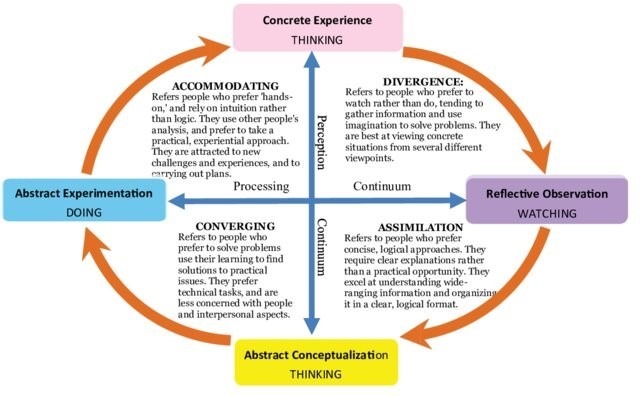
Fig.: Kolb’s Experiential Learning Cycle (1974)
In architecture and design education, courses typically emphasise practical, student-centred approaches. Experiential learning, for example, allows students to engage in hands-on projects and gain insights from real-world situations. Participative learning fosters collaboration, encouraging students to actively contribute to discussions and design projects, and enhancing critical thinking and communication skills. The curriculum’s integration of problem-solving methodologies enables students to systematically address complex design challenges, such as developing sustainable architectural solutions for community development. The School of Architecture and Design at K. R. Mangalam University has adopted these student-centred methods, transforming the learning experience. Faculty members now act as mentors and guides, creating a more dynamic and interactive educational environment and equipping students with practical skills to effectively tackle real-world design issues.
Experiential Learning: Experiential learning involves learning through direct experience, often in a real-world context. This approach involves immersive and interactive activities. The school integrates various experiential learning activities to enrich students’ educational journeys.
Activities under Experiential Learning
- Design Exercises/Project Work/Case Studies: Students tackle projects that apply architectural principles and design concepts, honing problem-solving and teamwork skills. Through these assignments, they refine their problem-solving abilities, develop teamwork skills, and gain experience in conceptualizing and executing design projects.
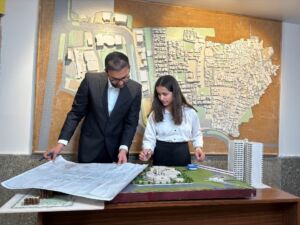
Photo: Design Project
- Construction Yard Activities: Students at K.R. Mangalam University receive firsthand experience with a variety of building materials, a thorough comprehension of construction methods, and useful knowledge of industry best practices. They have the chance to watch and take part in all stages of the building process, from the selection of building materials and site preparation to the application of safety procedures and the realization of complex construction details.

Photo: Students working at the KRMU construction yard.
- Field Visits and Site Visits: The School of Architecture and Design organised trips to expose students to diverse architectural styles and real-world projects, providing insights into architectural decisions influenced by culture, society, and the environment.
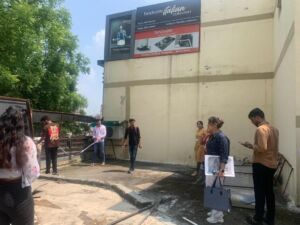
Photo: Students taking measurements at the site visit
- Industrial Visits/Survey: Students visit architectural firms, construction sites, and material markets, gaining practical insights and staying updated on industry trends.

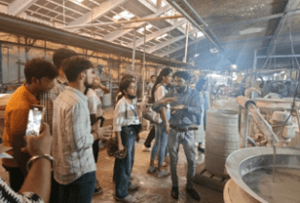
Photo: The many tile factory visits empowered students with an understanding of tile-making and storage techniques.
- Educational Tours and Student Exchange Programs: KRMU offers students the opportunities to broaden students horizons and expose them to architectural contexts. Educational tours often include guided visits to various landmark architectural sites, while exchange programs offer students the opportunity to experience different educational environments, broadening their perspectives on global architectural trends and practices.
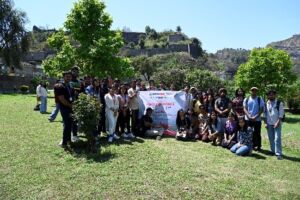

Photo: Educational trip to Dharamshala
- Group Discussions and Workshops: Regular group discussions and workshops encourage students to share their ideas, critique each other’s work, and collaboratively develop solutions to design problems. This fosters a spirit of cooperation and enhances their ability to articulate and defend their design choices.
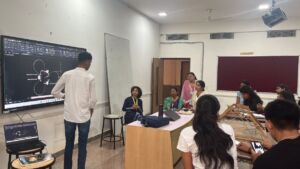
Photo: Group discussion for the NASA project
- Collaborative Design Projects: Students work in teams to tackle complex design challenges. These projects simulate professional architectural practice, requiring students to negotiate roles, share responsibilities, and integrate diverse viewpoints into cohesive design solutions.


Photo: The collaborative design studio exercise with BBDU Lucknow allowed students to get exposure to the teaching and learning of other HEIs.
- Community-Based Projects: These projects involve designing for real communities, and addressing their specific needs and challenges. Students gain a deeper understanding of the social and cultural dimensions of architecture, learning to create designs that are not only functional but also socially relevant and impactful.
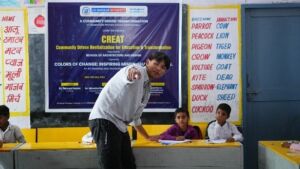

Photo: Students contributed to the community-driven revitalization for education and transformation (CREAT) initiative, spearheaded by the School of Architecture and Design (SOAD).
Conclusion
These experiential learning activities transcend traditional teaching, bridging theory and practice for a holistic architectural and design education. The mentorship, combined with a curriculum that emphasizes practical skills and real-world applications, ensures that students are well-prepared to effectively tackle the complex design issues they will face in their professional careers.
FAQs
Get quick answers to the most common questions about experiential learning in architecture and design.
What is experiential learning in architecture and design?
Experiential learning is a hands-on approach where students learn by doing through real projects, site visits, and practical design activities.
Why is experiential learning important for architecture students?
It helps students connect theory with real-world practice, improving creativity, problem-solving, and technical skills.
How does experiential learning benefit design students?
It enhances creativity, decision-making, and practical understanding through workshops, studio work, and collaborative projects.
What activities are included in experiential learning?
Activities include design projects, construction yard work, industrial visits, workshops, and community-based projects.

























 13+Years of Educational Experience