




























Top Degree Courses After 12th | Stream-Wise List & Scope
After the 12th, students stand at a crucial crossroad – a point where one decision can shape their future career. Choosing a degree course after Class 12 is one of the most important decisions in a student’s academic journey. However, many students select courses based on popularity, peer influence, or outdated perceptions of career success. The reality is that the employment landscape is changing rapidly due to technological advancements, digital transformation, artificial intelligence, and evolving industry needs.
Whether you dream of becoming a doctor, entrepreneur, artist, or engineer, choosing the right degree course can open countless opportunities. But how do you make the right choice?
This blog post examines popular degree courses after 12th through the lens of industry demand, career opportunities, future growth potential, and salary prospects.
Overview of This Blog
The table below highlights the key topics covered in this blog, including future industry trends, degree courses after 12th, salary potential, career opportunities, and factors to consider when choosing the right course and college.
| Sections | Descriptions |
|---|---|
| What Do Industry Trends Suggest About Future Careers? | Overview of emerging industries and sectors expected to witness strong growth in the coming years. |
| Degree Courses with Strong Future Potential | Popular degree programmes across technology, healthcare, psychology, law, business, agriculture, and design with career scope and salary insights. |
| Checklist for Students Before Choosing a Course After 12th | Important factors students should evaluate before selecting a degree programme. |
| Which College to Choose After 12th? | Key considerations for selecting the right university and introduction to K.R. Mangalam University. |
| Conclusion | Summary of key insights and guidance on making informed academic and career decisions after 12th. |
What Do Industry Trends Suggest About Future Careers?
The modern job market is undergoing significant transformation.
According to various industry studies, the following sectors are expected to witness sustained growth over the next decade:
| Growing Sector | Relevant Streams | Key Drivers |
|---|---|---|
| Technology & Artificial Intelligence | Science (PCM) | Digital transformation and automation |
| Healthcare & Allied Sciences | Science (PCB) | Increasing healthcare needs and ageing populations |
| Psychology & Mental Health | Arts and Science | Growing awareness of mental well-being |
| Law & Compliance | Arts and Commerce | Expansion of corporate and regulatory frameworks |
| Finance & Business Management | Commerce | Startup growth and global business expansion |
| Agriculture & Agri-Tech | Science (PCB/PCM) | Food security and sustainable development |
According to various industry studies, the following sectors are expected to witness sustained growth over the next decade: These trends suggest that students should consider not only their interests but also long-term industry demand when selecting a degree programme. Understanding emerging sectors and the skills they require can help students make more informed academic and career decisions.
What are the Degree Courses After 12th?
Degree courses after 12th are undergraduate programmes that students can pursue after completing their higher secondary education. These courses provide specialised knowledge and skills in a particular field and usually lead to a bachelor’s degree.
Eligibility Criteria for Degree Courses After 12th
The eligibility requirements for undergraduate degree courses vary depending on the course, specialisation, and university. However, students generally need to meet the following requirements:
- Educational Qualification: Candidates must have passed Class 12 or an equivalent examination from a recognised board.
- Minimum Marks: Most universities require a minimum aggregate percentage, which may generally range between 45% and 60%, depending on the programme.
- Subject Requirements: Certain courses require specific subjects in Class 12. For example, engineering generally requires physics and mathematics, while many healthcare and science courses require biology or other relevant science subjects.
- Stream Requirements: Some programmes are open to students from any stream, while others are restricted to science, commerce, or arts/humanities students.
- Entrance Examination: Certain professional courses may require candidates to qualify for a national, state, or university-level entrance examination.
- Personal Interview or Assessment: Some programmes may include a personal interview, aptitude test, counselling session, or other assessment as part of the admission process.
- Portfolio Requirement: Design and creative programmes may require students to submit a portfolio or participate in a portfolio evaluation, depending on the university.
- Age Criteria: Some professional programmes may have specific age requirements prescribed by the relevant regulatory authority or university.
- Programme-Specific Requirements: Additional eligibility conditions may apply depending on the course and institution.
Complete List of Degree Courses after 12th (Updated 2026)
Based on streams, current industry trends, technological advancements, and employment projections, the following degree courses are expected to remain highly relevant in the coming years:
Quick Overview: Degree Courses After 12th
| Field | Popular Degree Courses | Career Areas | Indicative Starting Salary* |
|---|---|---|---|
| Engineering & Technology | B.Tech CSE, AI & ML, Data Science, Cyber Security, Robotics & AI | Software, AI, cybersecurity, robotics, engineering | ₹4–15 LPA |
| Healthcare & Medical Sciences | B.Pharm, BPT, D.Pharm, B.EMT, B.RT | Hospitals, pharmaceuticals, diagnostics, healthcare | ₹3–8 LPA |
| Psychology | B.A. (Hons.) Psychology | Counselling, HR, research, education | ₹3–6 LPA |
| Law | BA LL.B., BBA LL.B., LL.B. | Litigation, corporate law, consulting, public policy | ₹4–12 LPA |
| Business, Commerce & Finance | BBA, B.Com. (Hons.), B.Sc. Finance, B.A. Economics | Banking, finance, consulting, management | ₹4–8 LPA |
| Agriculture & Sustainability | B.Sc. Agriculture, Forestry, Environmental Science | Agribusiness, research, sustainability | ₹3–7 LPA |
| Design & Creative Industries | B.Des., BFA, Fashion Design, Interior Design, UX/UI | Design, media, advertising, fashion | ₹3–8 LPA |
* Note: Salary figures are broad industry estimates and can vary depending on the role, employer, location, skills, experience, and individual performance.
Other Degree Courses Students Can Explore
Apart from these major fields, students can also consider programmes in:
- Hotel Management and Tourism
- Media and Journalism
- Education
- Computer Applications
- Liberal Arts
- Basic and Applied Sciences
- Architecture
- Social Work
- Performing Arts
Fees for Degree Courses After 12th in India
The fees for degree courses after 12th in India vary depending on the course, institution, specialisation, and duration of the programme. Professional courses such as engineering, management, law, medicine, and architecture may have higher fees, while programmes in humanities, commerce, and basic sciences can be comparatively affordable.
Students should compare the total programme fees, additional academic expenses, available scholarships, and financial aid options before choosing a degree course.
How Long Are Degree Courses After 12th?
The duration of degree courses after Class 12 varies depending on the programme and field of study. Most undergraduate courses take three or four years to complete, while professional programmes such as architecture and certain medical courses may take longer.
| Type of Degree Course | Typical Duration | Examples |
|---|---|---|
| Bachelor’s Degree | 3–4 years | B.A., B.Com., BBA, B.Sc. |
| Engineering & Technology | 4 years | B.Tech, B.E., BCA* |
| Management & Business | 3–4 years | BBA, BMS |
| Law (Integrated) | 5 years | BA LL.B., BBA LL.B. |
| Architecture | 5 years | B.Arch. |
| Design | 4 years | B.Des., BFA* |
| Healthcare & Allied Sciences | 3–4.5 years* | B.Pharm., BPT, B.Sc. Nursing |
| Agriculture | 4 years | B.Sc. Agriculture |
| Medical Degrees | 5–5.5 years | MBBS, including internship |
*The duration can vary depending on the university, programme structure, and applicable regulations.
Important Note
With the introduction of four-year undergraduate programmes and Honours with Research pathways, the duration of some traditional three-year courses may vary. Students should check the specific programme structure of their preferred university before applying.
In short, most degree courses after 12th take between three and four years, while specialised professional programmes can take five years or longer.
Which Is the Best Among Degree Courses After 12th?
There is no single best degree course after 12th for every student. The right choice depends on an individual’s interests, academic strengths, skills, and long-term career goals. A programme that offers excellent opportunities for one student may not necessarily be the right fit for another.
For example, students interested in technology and innovation may explore engineering or computer science programmes, while those interested in healthcare can consider pharmacy, physiotherapy, and other medical and allied health sciences courses. Similarly, students with an interest in business and finance may choose BBA, B.Com., Economics, or Finance programmes.
Emerging fields such as artificial intelligence, data science, cybersecurity, psychology, sustainability, and UX/UI design are also creating new career opportunities. However, students should not choose a course solely based on salary trends or popularity. It is important to consider the course curriculum, practical learning opportunities, future employability, and whether the subject genuinely aligns with their interests.
In simple terms, the best degree course after 12th is one that matches your strengths and interests while helping you build relevant skills for your future career.
Checklist for Students Before Choosing a Course After 12th
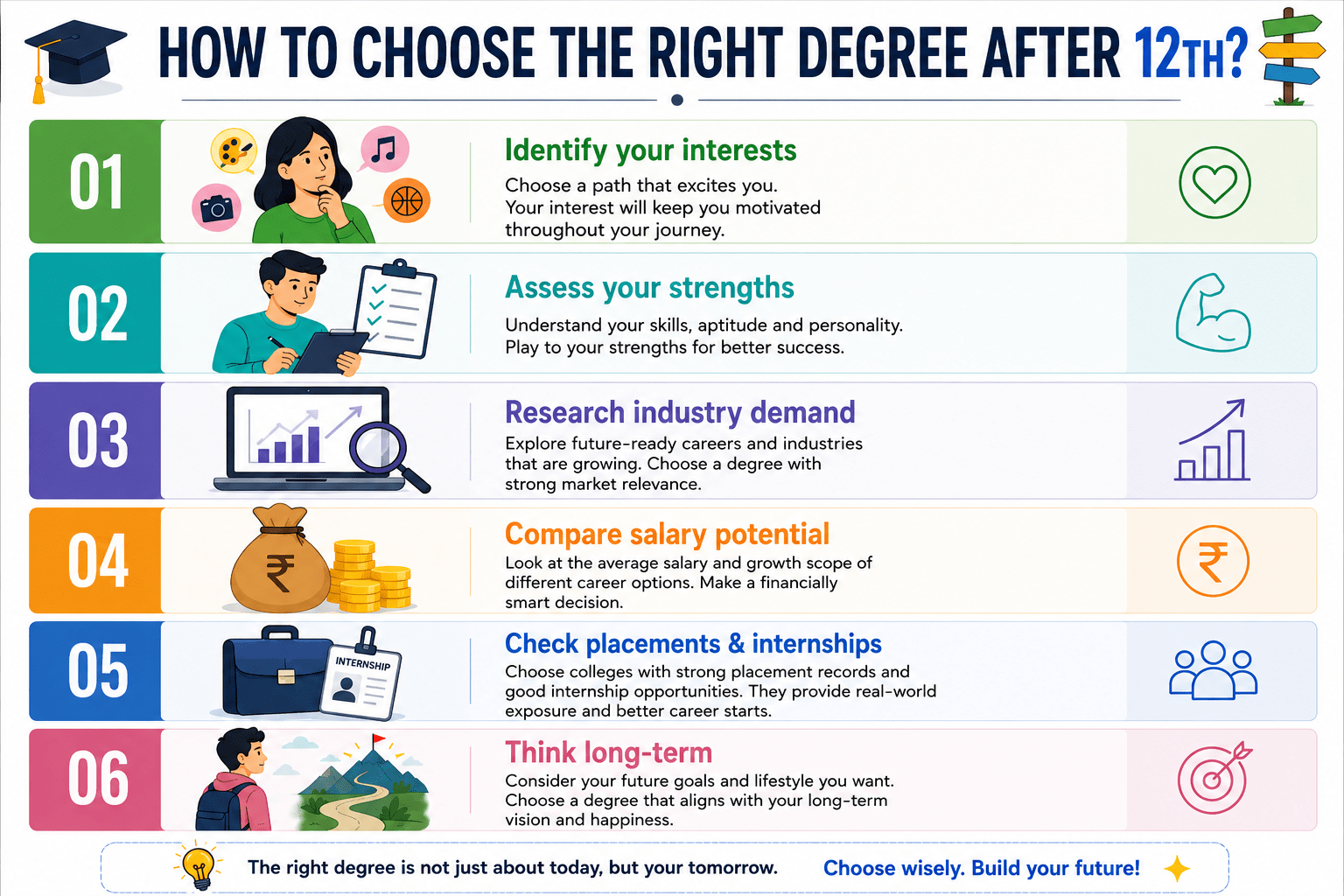
Other than considering industry trends and other aspects mentioned above, you need to follow the below checklist before choosing a course after 12th.
Identify Your Strengths and Interests
Before choosing any course it is essential to think about the subjects you enjoy and where your skills lie. Your passion should align with your academic and career goals to keep you motivated throughout your studies.
Research Course Content and Scope
It is essential to understand what each course covers, its specialisations, and future opportunities. Check if the syllabus includes practical exposure, internships, or projects that match your career aspirations.
Check Placement and Internship Records
After researching the course content you should review the university’s placement records, internship tie-ups, and alumni success stories. A strong placement network ensures better career opportunities after graduation.
Consider Fees and ROI
Carefully compare course fees, available scholarships, and average starting salaries. Ensure that the degree you choose offers a good return on investment in terms of future career growth.
Visit the Campus or Attend Counselling Sessions
If possible, visit the university to understand the environment, interact with faculty, or attend counselling sessions to clarify doubts before finalising your decision.
Think Long-Term
Choose a course that not only interests you now but also opens doors for higher education and career advancement in the future.
Why Select KRMU After 12th?
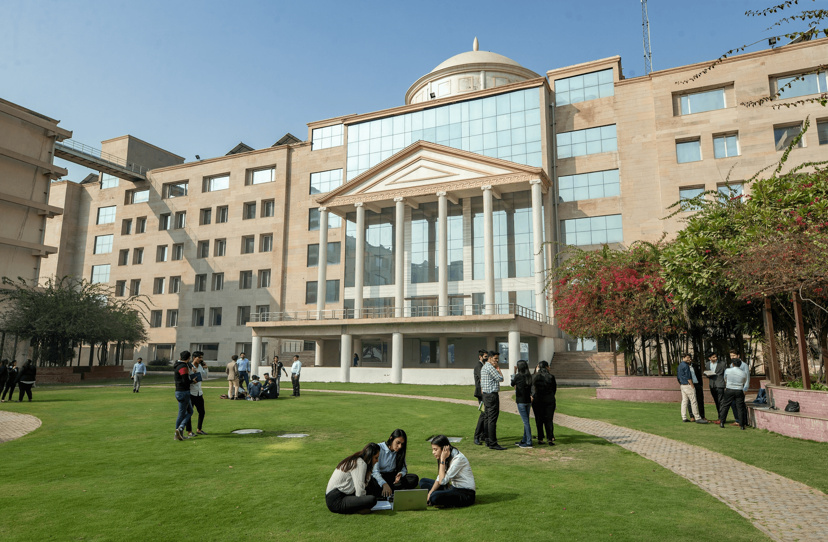
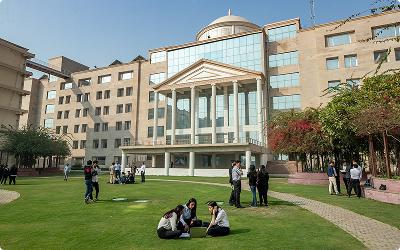
Students who have just completed their 12th grade must be looking for a college to pursue their preferred undergraduate programmes. Deciding on one college can be difficult, as there are so many options available. This is why we are here to make the process simpler. K.R. Mangalam University is one of the best universities in Delhi NCR. Located in Gurugram, KRMU builds a solid foundation for a successful career ahead. Now, let’s find out why you should pursue undergraduate courses here.
- The college is situated on a lush campus of 28-plus acres. Students get to enjoy a vibrant campus life with academic learning due to the top-notch facilities and infrastructure.
- The internships and placement opportunities are excellent as KRMU collaborates with top companies in India and abroad.
- The college offers global exposure by organising paid visits of 2 weeks (for selected students) to a prestigious European university.
- To make students’ dreams come true, the university has partnered with reputed banks like ICICI Bank, Axis Bank, IDFC First Bank, and more to offer education loans and financial assistance to students.
- Students get to learn from highly qualified professors, researchers, clinical psychologists, and industry experts with strong academic and professional backgrounds.
- Faculty members actively contribute to research, publications, conferences, and academic development, helping students build strong research skills.
- Students receive guidance from professionals with experience in counselling, clinical psychology, mental health, and applied psychology.
Entrance Exams for Degree Courses After 12th at KRMU
K.R. Mangalam University offers admission to a range of undergraduate degree programmes after Class 12. Depending on the programme and its admission requirements, candidates may need to meet the university’s eligibility criteria and appear for relevant entrance examinations. Some programmes may also consider scores from national-level entrance tests where applicable.
The process related to it generally involves selecting a preferred programme, completing the application form, submitting the required academic documents, and meeting the relevant eligibility criteria. Candidates may also be required to appear for an entrance examination or other selection process, depending on the programme. After the verification of documents and fulfilment of the admission requirements, eligible candidates can proceed with the remaining admission formalities.
Students are advised to check the specific eligibility, entrance examination, and admission requirements for their chosen programme before applying.
Conclusion
In today’s rapidly evolving job market, choosing the right degree course after 12th requires careful consideration of your interests, strengths, career goals, and future industry trends. While fields such as technology, healthcare, psychology, law, business, agriculture, and design continue to offer promising opportunities, the best course is ultimately the one that aligns with both your passion and long-term aspirations.
A strong academic foundation, practical exposure, and industry-relevant learning can significantly influence your career success. Institutions like K.R. Mangalam University help students prepare for the future through modern curricula, experienced faculty, global exposure opportunities, internships, and strong placement support. By making an informed decision today, you can build a rewarding and future-ready career tomorrow.
Join KRMU and make your future bright.
Also Read: What Are Some of The Best Professional Courses After 12th Class
FAQs
Are there any entrance exams for degree courses after 12th?
Yes, some degree courses require scores of entrance exams. For instance, if you want to take admission in engineering courses, some universities require scores of JEE Mains.
What are some of the advantages of pursuing a B.A degree?
B.A. degree offers diverse specialisations that helps in developing critical thinking and communication skills of the students.
What is the average salary offered to a B.Tech. graduate?
The average salary offered to a B.Tech. graduate may range from 2 to 10 lakh per annum.
What subjects will BFA include?
Some of the subjects included in BFA are clay modelling, still life, painting, and creative writing etc.